


Publications
A collection of books, workbooks, and educator tools designed to strengthen predictable, trauma‑informed practices.

FRAMEWORK PUBLICATIONS & WHITE PAPERS

INSTRUCTION FIRST, FINANCE ALIGNED: THE DUAL ROI™ FRAMEWORK FOR MODERN SCHOOL LEADERSHIP
A Three‑Layer Decision Architecture for Instructional, Stability, and Financial Alignment in K–12 Schools
A superintendent‑ready framework that reframes ROI for K–12 schools by sequencing instructional return, stability return, and financial impact.
The Dual ROI™ Framework gives school and district leaders a structured, trauma-informed approach for evaluating investments without reducing educational value to dollars alone. It helps leaders consider how a decision supports instruction, influences the conditions surrounding teaching and learning, and aligns with available resources.
The framework also provides a clear, transparent structure for communicating the rationale behind investments to boards, staff, families, and communities.
Because in education, the most important return isn't always the easiest one to put on a balance sheet.

REFRAMING SCHOOL SAFETY: EQUIPMENT, ADULT BEHAVIOR, AND THE DUAL-RISK MODEL
A TIRRA+™ Framework Publication
A clear introduction to the TIRRA+™ Dual-Risk Model and its examination of two interconnected dimensions of school safety: physical conditions and the human systems responsible for understanding, implementing, and experiencing them.
This publication explores how physical safeguards, emergency preparedness, adult practice, communication, relationships, and student experience interact within the larger school-safety system.
Rather than evaluating physical security and human factors in isolation, the Dual-Risk Model encourages school and district leaders to examine how the two dimensions connect, where gaps may exist, and whether existing safety measures are working together as intended.
Because understanding school safety requires looking not only at the measures in place, but at the people and systems responsible for making those measures work.

How TIRRA+™ Strengthens Both the Human and Physical Layers of School Safety
A TIRRA+™ Framework Publication
A clear, accessible exploration of how TIRRA+™ connects the human and physical dimensions of school safety within a systems-aligned approach.
This publication examines how predictable adult practice, communication, relationships, developmental considerations, and student experience interact with physical safeguards, emergency procedures, preparedness, and the built environment.
Rather than treating physical security and the human experience of safety as separate concerns, the publication helps school and district leaders understand how the two influence one another and why alignment between them matters.
Because effective school safety requires more than individual measures. It requires understanding how the pieces work together.

Safety Isn't a Program, It's a Language
A TIRRA+™ Framework Publication
A concise exploration of why effective school safety requires more than programs, policies, and procedures. It requires shared language and common understanding among the people responsible for carrying them out.
This publication examines how clear communication, predictable adult practice, consistent expectations, and developmentally appropriate responses help connect the different parts of a school's safety system.
Through the TIRRA+™ perspective, school and district leaders are encouraged to look beyond whether safety measures simply exist and ask a more important question:
Do the people responsible for safety share a common understanding of what those measures mean and how they should be applied?
Because a safety system becomes stronger when its language is clear, understood, and consistently translated into practice.

CPTED Meets Trauma-Informed Practice: Designing Schools That Support Both Security and the Human Experience of Safety
A TIRRA+™ Framework Brief
This brief explores a central TIRRA+™ principle: physical design and human practice should be examined together rather than as separate school-safety concerns.
Using the image of a path and stream meeting at a steady bridge, the brief illustrates how CPTED principles and trauma-informed practice can connect within the same safety system.
CPTED helps leaders consider how visibility, access, movement, territoriality, maintenance, and environmental conditions affect safety. Trauma-informed practice adds another lens by examining how communication, predictability, relationships, developmental needs, and adult response shape the human experience of those conditions.
The brief gives school and district leaders an accessible way to consider how physical safeguards, environmental design, adult practice, and everyday routines can support one another in real school settings.
Because the physical environment influences how safety operates, while people determine how that environment is understood and used.
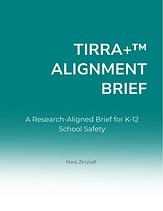
TIRRA+™ ALIGNMENT BRIEF
A TIRRA+™ Framework Publication
A concise overview of how the TIRRA+™ Framework draws from and connects with established principles in trauma-informed practice, multi-tiered systems of support, developmentally appropriate practice, school-safety guidance, and crisis readiness.
The brief helps school and district leaders understand where TIRRA+™ principles intersect with established approaches while clarifying the framework's distinct emphasis on predictability, systems alignment, adult practice, communication, and the connection between physical and human dimensions of school safety.
TIRRA+™ is not intended to replace existing district frameworks. It provides a structure for understanding how those practices can connect within the larger school-safety system.

TIRRA+™ METHODOLOGY & VALIDATION BRIEF
A TIRRA+™ Framework Publication
A detailed explanation of the evaluation structure, evidence-gathering process, and validation logic behind the TIRRA+™ Certified Dual-Risk School Safety Evaluation and Validation Framework.
This brief explains how information from physical-security conditions, adult practice, communication, student experience, climate and culture, emergency readiness, leadership alignment, and scenario-based review is brought together to develop a more complete picture of a school's existing safety system.
It also explains how assessment findings are documented, compared across multiple sources of information, and translated into leadership-ready strengths, gaps, priorities, and recommendations.
The purpose is to make the TIRRA+™ assessment methodology clear, repeatable, and transparent, so school and district leaders can understand not only the findings, but how those findings were reached.

TIRRA+™ IMPLEMENTATION FIDELITY BRIEF
A TIRRA+™ Framework Publication
A clear overview of the implementation indicators and practice expectations that help schools apply TIRRA+™ consistently while remaining developmentally appropriate and responsive to context.
This brief identifies the core adult-practice, communication, relational, routine, leadership, and environmental practices associated with the TIRRA+™ approach across classrooms, common areas, daily operations, and higher-stress situations.
Rather than requiring identical practice in every setting, the brief gives school and district leaders a shared structure for examining whether the principles of TIRRA+™ are being understood, applied, and reinforced consistently across the organization.
Implementation fidelity does not mean rigid uniformity. It means preserving the essential principles of the framework while allowing appropriate professional judgment and developmental responsiveness.

TIRRA+™ COMPLIANCE & NATIONAL ALIGNMENT BRIEF
A TIRRA+™ Framework Publication
A clear overview of how the TIRRA+™ Framework and Certified Dual-Risk School Safety Evaluation and Validation Framework draw from and connect with established K–12 school-safety guidance, trauma-informed principles, developmentally appropriate practice, and systems-based approaches to safety.
This brief helps school and district leaders understand where TIRRA+™ principles correspond with established guidance, how the framework can complement existing plans and practices, and where district-specific requirements may require additional review.
Rather than presenting TIRRA+™ as a substitute for federal, state, or local requirements, the brief provides a structured way to examine how physical safety, preparedness, adult practice, communication, relationships, leadership, and student experience connect within the broader school-safety system.
TIRRA+™ is designed to complement existing safety requirements and practices, not replace the responsibility to evaluate applicable federal, state, and local requirements.
GUIDES & IMPLEMENTATION TOOLS

POWERED RESPONSE™
Trauma-Informed Crisis Readiness for School Professionals
Powered Response™ gives school professionals a clear, shared structure for responding during conflict, dysregulation, uncertainty, and safety-related situations.
Rather than relying solely on instinct or intensity, adults use a predictable, trauma-informed approach that supports steady adult response, clear communication, developmentally appropriate decision-making, and relational awareness.
Powered Response™ does not prescribe an identical response for every situation. It provides a common framework that helps adults slow the moment down, assess what is happening, communicate clearly, and respond with greater consistency when conditions become difficult.

EMPOWERED RESPONSE™
A TIRRA+™ Framework for Bullying Prevention & Response
EMPOWERED RESPONSE™ gives school leaders and staff a clear, trauma-informed framework for recognizing, preventing, and responding to bullying through predictable adult practice.
Grounded in TIRRA+™ principles, the framework helps schools strengthen early recognition, shared expectations, consistent adult response, clear reporting pathways, relational awareness, and appropriate follow-through.
Rather than treating bullying as a series of isolated incidents, EMPOWERED RESPONSE™ helps schools consider how adult practice, communication, relationships, reporting, accountability, and schoolwide systems work together to support a more consistent approach to bullying prevention and response.
BOOKS & LONG FORM WORKS

TIRRA+™ Core Framework
A Trauma‑Informed Systems-Aligned Model for School Safety
The TIRRA+™ Core Framework establishes the conceptual foundation of the TIRRA+™ School Safety & Crisis Readiness System.
This foundational volume introduces a developmentally grounded, trauma-informed approach to understanding how physical conditions, adult practice, communication, relationships, preparedness, and student experience interact within the larger school-safety system.
Through the TIRRA+™ Dual-Risk lens, leaders can examine both the physical and human dimensions of safety and better understand why alignment between the two matters.
The Core Framework provides the shared language, developmental principles, and systems architecture that guide the broader TIRRA+™ approach.

TIRRA+™ School Safety & Crisis Readiness Implementation System
Operational Tools for Consistent, Trauma‑Informed Practice Across the School Day
The TIRRA+™ Implementation System translates the principles of the Core Framework into practical, repeatable school-safety practices across classrooms, common areas, daily routines, and higher-stress situations.
This volume provides school leaders and staff with structured tools for strengthening predictable adult practice, clear communication, aligned expectations, developmentally appropriate student actions, leadership consistency, and crisis readiness.
Rather than prescribing identical responses in every situation, the Implementation System provides a shared structure for translating safety principles into clear, consistent, and developmentally appropriate practice.
It is where the “what” and “why” of the TIRRA+™ Core Framework become the “how” of everyday school safety.

PROTECTING THE NEXT GENERATION
A Veteran's Guide to Trauma-Informed School Safety
School safety isn't just about locked doors. It's about the systems, relationships, and culture surrounding them.
In this practical guide, retired U.S. Navy Senior Chief Mark T. Zirtzlaff brings together operational preparedness, trauma-informed practice, and youth development to explore how schools can strengthen both the physical and human dimensions of safety.
A practical, grounded approach to moving school safety beyond a checklist and toward a culture built on preparedness, predictability, trust, and partnership.

ASSESSING THE FUTURE
A Trauma-Informed Framework for School Safety Evaluation
School safety isn't defined only by what we stop. It's also defined by what we strengthen.
Assessing the Future introduces a systems-based, trauma-informed approach to evaluating school safety through both its physical and human dimensions.
Through the TIRRA+™ Dual-Risk lens, the book encourages leaders to look beyond checklists and isolated safety measures to examine how physical conditions, preparedness, adult practice, communication, relationships, leadership, and student experience work together.
A practical guide for school leaders seeking to better understand what is working, where systems may be disconnected, and what deserves priority for improvement.

The Day Everyone Almost Missed
A middle‑grade novel about noticing the small things that matter.
The Day Everyone Almost Missed follows four students as they navigate a week of misunderstandings, quiet worries, and almost‑missed moments. Through gentle, rotating perspectives, the story shows how kids read the emotional world around them, and how easily adults can miss what students see clearly.
Written with trauma‑informed care and emotional steadiness, this fiction title is ideal for classroom libraries, SEL discussions, and advisory programs. It gives students a safe, relatable story about friendship, communication, and the power of slowing down long enough to understand one another.
STUDENT & COMMUNITY RESOURCES
These resources are available in print through Barnes & Noble
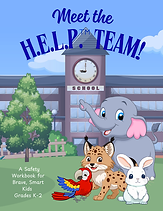
Meet the H.E.L.P.™ TEAM!
Meet the H.E.L.P. Team! introduces young learners to four calm, friendly characters who teach safety in a way kids can actually understand. Through simple language, visual storytelling, and developmentally appropriate steps, children learn how to stay safe without fear—using tools that build confidence, clarity, and emotional readiness.

Stand Up with H.E.L.P.™
A Workbook for Bullying Prevention
Stand Up with H.E.L.P.™ teaches kids how to speak up, set boundaries, and advocate for themselves and others with confidence. Through relatable scenarios and calm, supportive language, students learn what it means to notice unsafe behavior, stand firm in their voice, and seek help from trusted adults—without fear, shame, or overwhelm.

You’ve Got H.E.L.P.™
Safety, Confidence, and Smart Choices
You’ve Got H.E.L.P.™ gives kids the confidence to recognize unsafe situations and take action with calm, age‑appropriate steps. Through simple language, visual cues, and supportive scenarios, students learn how to listen to their instincts, seek help from trusted adults, and use the H.E.L.P.™ steps in ways that feel safe—not scary.

The Student Safety & Belonging Workbook™
Trauma-Informed Tools for Middle School Advisory, SEL, and Safety Culture
The Student Safety & Belonging Workbook™ helps middle‑grade students build the real‑world skills they need to feel safe, connected, and confident at school. Through calm, developmentally appropriate activities, students learn how to recognize emotions, set boundaries, seek help from trusted adults, navigate digital spaces, and strengthen their personal safety networks. Every page is designed to reduce fear, build self‑awareness, and support a stronger sense of belonging—one predictable, trauma‑informed step at a time.

How to Navigate Middles School Conflict Without Making It Bigger
A Predictable Safety Student Guide for Grades 6-8
This resource gives teaching teams a clear, predictable lesson structure that helps students understand conflict, slow down their reactions, and choose safer responses. Trauma‑informed language, real‑world examples, and step‑by‑step routines make it easy for educators to deliver lessons that reduce drama, strengthen relationships, and build emotional safety across the school day.